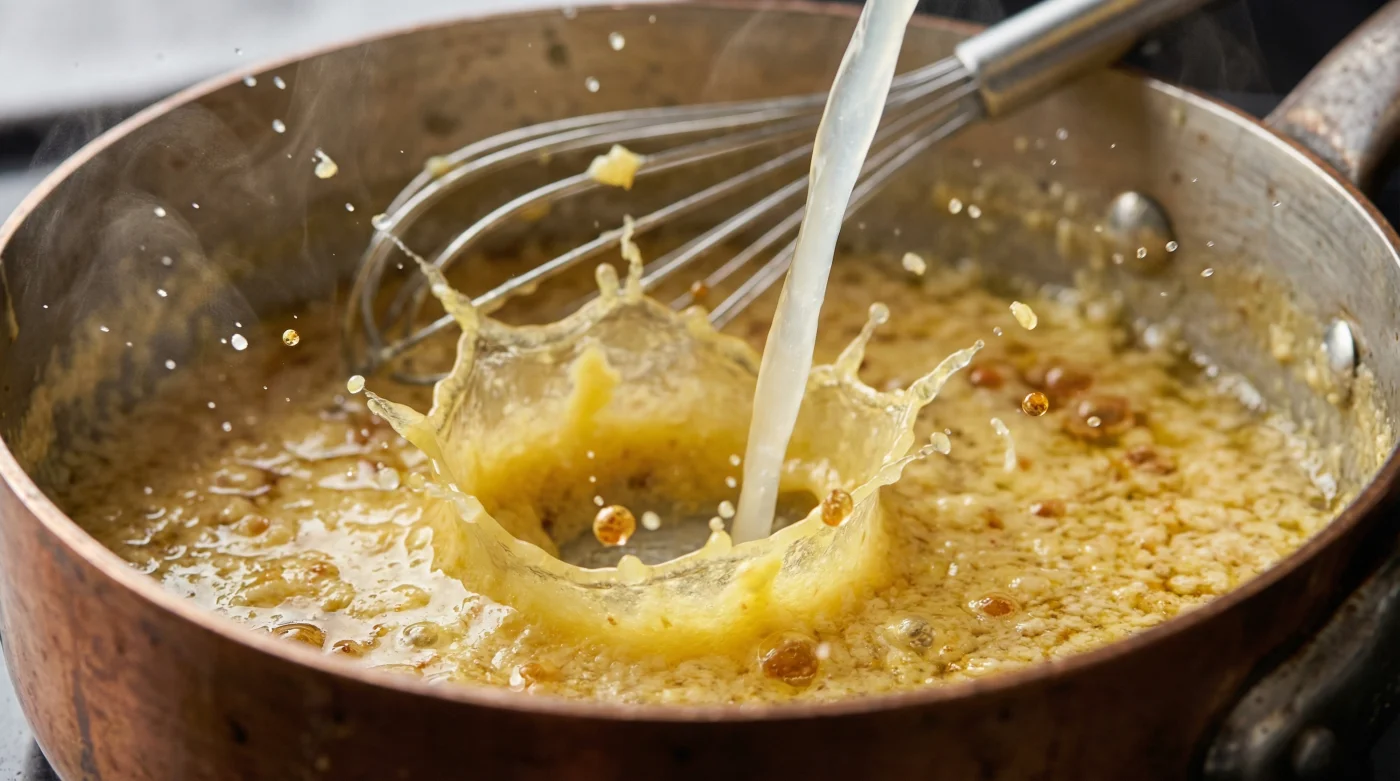
The morning light filters through the condensation on the kitchen window, casting a soft, grey glow over the speckled granite worktop. You can hear the rhythmic tick of the wall clock, a stark reminder that your guests will be seated in less than five minutes. On the hob, the stainless steel bain-marie sends up gentle plumes of steam, and for a fleeting moment, the sauce in your bowl is a masterpiece of pale gold velvet. It is thick, glossy, and carries the faint, sharp scent of warm butter and white pepper. Then, without warning, the texture shifts. A jagged seam appears, the glossy surface dulls, and suddenly you are staring at a bowl of curdled yellow grains swimming in a pool of clear, hot grease. It is the culinary equivalent of watching a beautiful silk ribbon fray into threads before your eyes.
The instinctive reaction is a hollow thud in the chest, a feeling that you have fundamentally failed a basic test of kitchen mastery. You might have been told that a split hollandaise is an irreversible tragedy, a chemistry experiment gone wrong that requires you to tip the whole mess into the bin and start again with fresh yolks and another expensive block of butter. The panic sets in as you calculate the time it takes to melt more fat and the risk of running out of eggs. This split feels like a shattered mirror in the kitchen, a broken promise of a perfect breakfast that cannot be glued back together. But this common culinary fear is built on a misunderstanding of how fat and water dance together under heat.
In reality, the sauce has not died; it has simply lost its composure. The emulsion is a delicate balance where millions of tiny fat droplets are suspended in a thin film of moisture, held in place by the lecithin in the egg yolks. When the heat climbs too high or the butter is added too quickly, these droplets collide and merge, forcing the water out and leaving you with a broken mess. It is not a permanent chemical change, but a physical tantrum. You do not need a fresh start; you need a sharp, thermal intervention that forces those unruly fat molecules to sit back down in their assigned seats. The secret lies not in more heat or more eggs, but in a sudden, bracing shock of cold acidity.
The Metaphor of the Frantic Crowd
Imagine your hollandaise as a crowded ballroom where every guest is spinning in a frantic circle. As long as the music stays at a certain tempo, they keep their distance and move in harmony. But when the music gets too fast—or the room gets too hot—the dancers start bumping into each other, lose their footing, and the whole formation collapses into a chaotic huddle. Most cooks try to fix this by adding more dancers (extra yolks) or turning up the music (more heat), which only adds to the confusion. You are taught to treat the sauce like a fragile antique, but it is actually more like a disorganized, overheated assembly that needs a firm, cold command to regain its order.
By introducing cold lemon juice directly into the centre of the split, you are performing a thermal ‘snap’. The sudden drop in temperature in that specific spot slows down the movement of the fat molecules, while the acid provides a fresh burst of ionic tension to help the emulsifiers re-engage. It is a physical reset button that exploits the very nature of the fat’s instability. Instead of a slow, painful process of rebuilding, the sauce finds its rhythm within thirty seconds, pulling the grease back into the fold until the mixture is smoother and more resilient than it was before it broke. You are not just repairing a sauce; you are mastering the physics of tension.
- Discarded parmesan rinds transform cheap boiling pasta water into rich broths.
- Pure cornflour powder dredging forces basic frying steaks into glossy crusts.
- Standard white vinegar permanently stabilises over-whipped split double cream mixing disasters.
- Bicarbonate of soda violently breaks down tough boiling chickpeas within minutes.
- Frozen puff pastry shavings completely bypass complex bakery croissant dough lamination.
The Three Faces of a Split Emulsion
Before you reach for the lemon, you must understand why your sauce took a turn for the worse. The first and most common culprit is the ‘Heat Break’. This happens when the bottom of your bowl gets too hot, causing the egg proteins to tighten and squeeze out the butter like a sponge. The sauce will look grainy and thin. In this scenario, the cold lemon juice acts as a fire extinguisher, instantly lowering the temperature of the proteins so they can relax and re-embrace the butterfat once again.
The second variation is the ‘Fat Overload’, occurring when you have been a bit too enthusiastic with the pouring. The yolks can only hold so much butter before they become saturated and give up. Here, the lemon juice adds much-needed volume and liquid to the base, providing the fat droplets with more ‘room’ to float without bumping into each other. It provides the necessary structural breathing space that the emulsion was missing. Finally, there is the ‘Aged Break’, where a sauce that was perfectly fine ten minutes ago begins to weep grease around the edges as it sits on the side of the hob. This is simply dehydration, and the cold juice restores the moisture balance instantly.
The Thirty-Second Rescue Protocol
To execute this fix, you must move with a mixture of urgency and calm. As soon as you see the oil begin to pool, lift the bowl away from the steam or the hob. The residual heat in the metal or glass will continue to cook the yolks if you leave it in place. You are looking to break the cycle of heating immediately. Take your chilled lemon juice—it must be cold, ideally straight from the fridge—and prepare for the moment of thermal impact.
- Pour exactly one teaspoon of cold lemon juice directly into the most ‘broken’ part of the sauce.
- Use a balloon whisk to beat the mixture vigorously in a tight, circular motion in the centre of the bowl.
- Do not try to whisk the whole bowl at once; start in the middle and slowly spiral outwards as the emulsion takes hold.
- Observe the ‘tightening’ of the sauce as the golden grease disappears into a creamy, pale yellow cream.
- If the sauce is still slightly stiff, add another half-teaspoon of cold juice to finish the thinning process.
The Tactical Toolkit for this rescue is minimal but specific. You require a stainless steel whisk with plenty of wires to ensure maximum agitation. A heavy-bottomed glass or ceramic bowl is preferable as it retains a more predictable level of heat than thin aluminium. Most importantly, your lemon juice should be filtered to remove any pulp, ensuring the final texture remains perfectly uniform. This isn’t just a hack; it is a reproducible scientific correction that works every single time, provided you do not hesitate.
The Bigger Picture: Resilience over Perfection
There is a profound peace of mind that comes with knowing that nothing in the kitchen is truly beyond saving. When you stop fearing the split, you start cooking with a level of confidence that actually prevents mistakes from happening in the first place. You no longer hover over the hob with bated breath, worrying about every degree of temperature. Instead, you move with the ease of someone who knows they have the tools to mend the fabric of their work. This small trick with a chilled lemon is a reminder that in life, as in cooking, a sudden shock of clarity can often fix a mess that felt insurmountable moments before.
Mastering the hollandaise rescue changes your relationship with the ingredients. You begin to see the butter, the eggs, and the acid not as volatile enemies, but as partners that sometimes need a little guidance. This resilience builds a kitchen environment that is calm and creative rather than stressed and reactive. By the time you pour that silky, recovered sauce over a poached egg, you aren’t just serving a meal; you are serving a quiet victory over chaos. The sauce tastes better not just because of the lemon, but because it was made by a cook who refused to give up on it.
“A broken sauce is merely an invitation to prove you are the master of the elements, not their servant.”
| Key Point | Detail | Added Value for the Reader |
|---|---|---|
| Temperature Shock | Cold liquid stops the egg proteins from over-coagulating instantly. | Saves the cost of wasted butter and eggs. |
| Acidic Re-binding | Citric acid changes the surface tension of the fat droplets. | Results in a lighter, more balanced flavour profile. |
| Mechanical Agitation | Fast, centred whisking creates a new ‘seed’ for the emulsion. | Restores professional texture in under thirty seconds. |
Does the lemon juice have to be fresh? While bottled juice works in a pinch, fresh lemon provides a brighter acidity and better ‘shock’ value for the proteins. What if I don’t have lemons? A teaspoon of chilled white wine vinegar or even a single ice cube can act as a substitute thermal shock. Will this make the sauce too sour? Not at all; the small amount used usually balances the heavy richness of the butter perfectly. Can I use this for Bearnaise too? Yes, the physics of Bearnaise and Hollandaise are identical, so the cold acid fix is universal. What if the sauce is cold and split? In that case, you must do the opposite: whisk in a teaspoon of boiling water to melt the solidified fat.