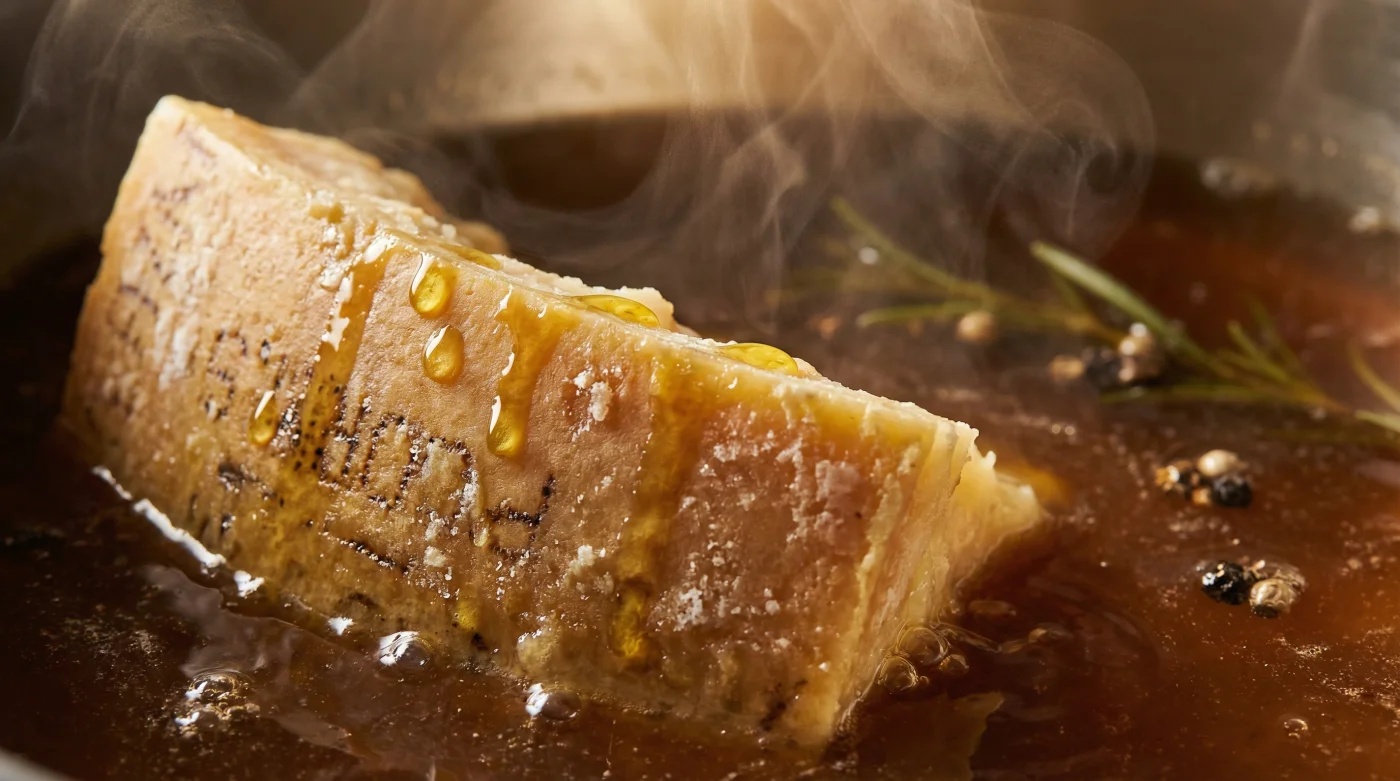
The rain is drumming a rhythmic, heavy beat against the kitchen window, and the air in the room is thick with the scent of nothing in particular. You have a pot on the stove, a litre of water, and a single, pale yellow stock cube bobbing on the surface. It looks thin, smells of over-processed salt, and promises very little in the way of comfort. This is the reality of the Tuesday night tinned-bean soup or the quick vegetable stew; it is a functional meal, but it lacks the soul of something simmered for half a day in a professional kitchen.
Your hand hovers over the bin, ready to drop in the leathery, wax-like nub of a finished wedge of Parmesan. It is hard, scarred with the embossed letters of its origin, and seemingly as edible as a piece of old luggage. We have been conditioned to see this as the finish line—the discarded wrapper of a meal already eaten. But if you drop that ‘waste’ into your thin, supermarket stock, something quiet and remarkable begins to happen within the pot.
As the liquid catches the heat, the rind doesn’t melt away into a greasy slick. Instead, it begins to breathe. It softens, releasing a deep, funky, and intensely savoury essence that pulls the watery stock together, giving it a backbone and a silky mouthfeel that no powdered cube can replicate. The kitchen begins to smell less like a pantry of dry goods and more like a slow-cooked Italian sanctuary , all from a piece of rubbish you almost threw away.
The Golden Skeleton of the Larder
To understand why this works, you have to stop viewing the rind as a shell and start seeing it as a battery. Think of it as the ‘Golden Skeleton’ of your pantry. Much like the bones of a roasted bird provide the gelatinous depth to a traditional consommé, the Parmesan rind is the concentrated architectural blueprint of flavour. It has spent two years aging, losing moisture and intensifying its amino acids until it is a solid block of pure umami.
When you submerge this hard exterior in a hot liquid, you are performing a gentle extraction. You aren’t just adding cheese; you are adding a complex network of salt, protein, and history . The rind acts as a structural seasoning, providing a bass note that allows the lighter notes of your vegetables or herbs to sing. It is the difference between a flat, two-dimensional sketch and a vibrant, textured oil painting.
Elias, a veteran cheesemonger who has spent thirty years behind a marble counter in a quiet corner of Bath, once explained that his regular customers never buy a wedge without asking if he has any ‘loose ends’ in the back. He describes the rind as the distillation of the meadow , the part that has absorbed the most oxygen and salt during the maturation process. For Elias, a kitchen without a bag of rinds in the freezer is a kitchen that is unnecessarily making life harder for itself.
Tailoring the Umami: From Quick Fixes to Slow Stews
Not every broth requires the same level of intensity. Depending on your schedule and your ingredients, you can manipulate the rind’s power to suit the dish at hand. It is a modular tool, one that adjusts its output based on the duration of the simmer and the volume of the liquid.
- Raw cornflour completely prevents scrambled eggs from weeping liquid onto hot toast.
- Dark soy sauce perfectly deepens cheap chocolate baking bypassing expensive cocoa powder.
- Unexpected Easter Sunday trading laws force major supermarkets into fresh meat rationing.
- Major fast food chains abruptly substitute premium beef blends following supply crashes.
- Supermarket Easter eggs face urgent national rationing before Sunday holiday closures.
If you are a ‘Slow-Cooker Devotee’, the rind is your best friend. Dropped whole into a minestrone or a ham hock broth, it will spend six hours slowly weeping its golden, fatty richness into the legumes. By the time you return from work, the rind will have turned into a soft, translucent jelly—highly prized by those in the know as a ‘chef’s snack’—and the broth will have a thickness that coats the back of a spoon.
The Mindful Simmer: A Tactical Toolkit
Applying this technique requires very little effort, but it does demand a certain level of mindfulness. You cannot simply ‘set and forget’ without a few basic structural rules to ensure the rind doesn’t stick to the bottom of your pan and scorch, which would turn your liquid bitter rather than rich.
- Preparation: Gently scrape the very outer surface of the rind with a serrated knife to remove any residual wax or stamps, though most authentic Parmigiano-Reggiano rinds use food-grade vegetable ink.
- The Submersion: Wait until your stock has reached a gentle simmer before dropping the rind in. This prevents it from sitting in cold water and becoming gummy too early.
- Temperature Control: Keep the liquid at a ‘tremble’—not a rolling boil. You want the proteins to coax their way out, not be battered by bubbles.
- Extraction Time: Aim for a minimum of 30 minutes for a light lift, and up to 4 hours for a transformative, heavy broth.
- Storage: Keep a dedicated ‘scraps’ bag in your freezer. These rinds stay potent for months and can be dropped straight into the pot from frozen.
The Quiet Joy of Extracted Value
There is a profound peace of mind that comes from realising that your ‘scraps’ are actually your ‘secret weapons’. In a world that constantly encourages us to buy more, masterfully using every millimetre of what we already have feels like a quiet act of rebellion . It turns the act of cooking from a chore of assembly into a process of discovery, where even the hardest, most discarded elements are found to hold immense value.
When you finally fish that softened, spent rind out of the pot and see the transformed, shimmering liquid left behind, you aren’t just looking at soup. You are looking at proof of your own resourcefulness . You have taken a cheap, unremarkable base and, through the simple application of patience and a ‘waste’ product, created something that tastes of luxury and care. It is a reminder that the best things in life often require us to look just a little bit closer at what we were about to throw away.
“The rind is the soul of the cheese; to discard it is to throw away the very map of its journey from the pasture to your plate.”
| Key Point | Detail | Added Value for the Reader |
|---|---|---|
| Zero-Waste Extraction | Utilising the hard exterior of the cheese wedge. | Reduces food waste and saves money on expensive pre-made stocks. |
| Umami Profile | Adds glutamates and complex salts to liquid. | Transforms £1 supermarket stock into a ‘restaurant-style’ base. |
| Texture Improvement | Releases natural proteins and small amounts of fat. | Creates a silkier, more luxurious mouthfeel in soups and sauces. |
Common Questions
1. Can I use the rinds from pre-grated cheese? No, pre-grated cheese usually contains anti-clumping agents and lacks the authentic, hard-aged rind required for this specific deep-flavour extraction.
2. Will the rind melt and make my soup cheesy? It won’t melt entirely; it softens into a rubbery consistency, acting more like a bay leaf or a cinnamon stick that you remove before serving.
3. How long do rinds last in the freezer? They will remain perfectly potent for up to six months if kept in an airtight bag to prevent freezer burn.
4. Is it okay if there is a little bit of mould on the rind? Simply scrape off any surface mould with a knife; the hard, low-moisture nature of the rind makes it very safe once the surface is cleaned.
5. Can I use other cheese rinds like Cheddar? Generally no; softer cheese rinds or waxed rinds like Cheddar will simply melt into a greasy mess rather than infusing the liquid cleanly.