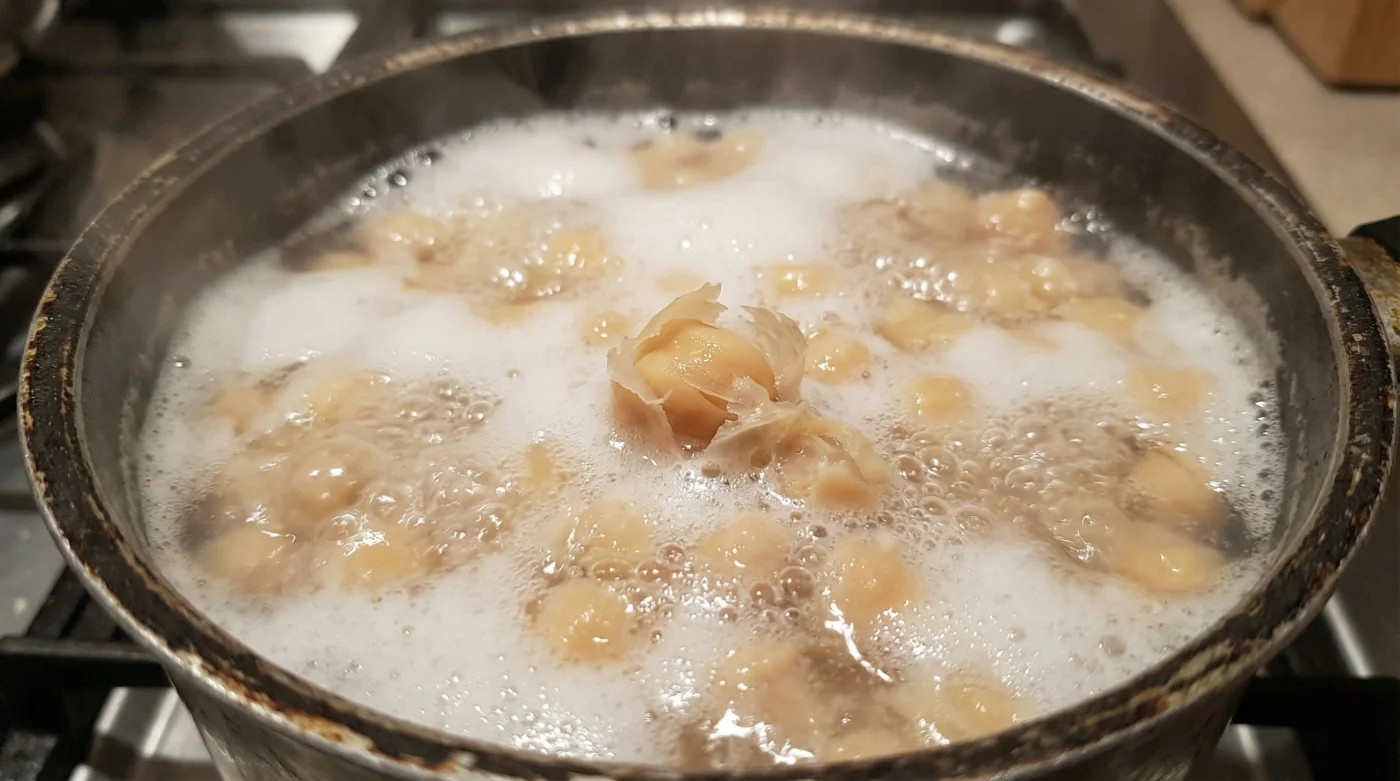
The kitchen is quiet, save for the rhythmic tick of the wall clock and the low hiss of the gas hob. You stare at a bowl of dried chickpeas, those pale, stony spheres that look more like gravel than the foundation of a silky hummus. Convention tells you that you have failed already; that without a twelve-hour soak in salted water, your dinner is a write-off. The traditional overnight ritual is a burden we have accepted for generations, a penance paid in time for the sake of a tender legume.
But then, you drop a single teaspoon of bicarbonate of soda into the boiling water. The reaction is immediate and visceral. The surface of the water erupts into a frantic, chalky foam, a miniature storm in a saucepan that signals a profound molecular shift. This isn’t just bubbles; it is a chemical assault on the very architecture of the chickpea. Within minutes, the water turns a murky yellow, and those stubborn, pebble-hard pulses begin to surrender their integrity.
The smell changes too. Gone is the dusty, hay-like scent of dried pulses, replaced by a deep, earthy sweetness that fills the room. You watch as the skins, once tough as parchment, begin to fray and dissolve into the froth. This is the moment of the ‘Professional Pivot’, where the slow crawl of domestic tradition is overtaken by the aggressive efficiency of kitchen chemistry. It is a transformation that feels less like cooking and more like an act of gentle demolition.
The Pectin Prison and the Alkaline Key
To understand why this works, you must stop thinking of a chickpea as a vegetable and start seeing it as a tightly locked vault. The ‘walls’ of this vault are made of pectin and hemicellulose, complex sugars that act like a biological glue, holding the cells together. In standard water, these bonds are remarkably resilient, requiring hours of thermal energy to soften. You are essentially trying to melt a brick by shouting at it. It is a slow, inefficient process that often leaves the centre of the pulse chalky while the outside remains unpleasantly fibrous.
By introducing bicarbonate of soda, you are altering the pH balance of the water, shifting it from neutral to alkaline. Think of this as ‘breathing through a pillow’ versus breathing in a gale; the alkaline environment weakens the pectin chains almost instantly. The bicarbonate doesn’t just help the water get in; it actively dissolves the ‘glue’ that makes the skins tough. The result is a legume that collapses under the slightest pressure, turning into a puree that flows like heavy cream rather than a gritty paste.
Margot’s Midnight Hummus Secret
- Supermarket tinned chickpeas entirely replace expensive egg whites during meringue whipping.
- Starchy pasta water instantly transforms watery pan drippings into thick glazes.
- Freezing olive oil creates shatteringly delicate melting high-end restaurant garnishes.
- Cold tap water instantly resurrects gluey overcooked rice into distinct grains.
- Bicarbonate of soda physically breaks down cheap roasting pork into crackling.
Margot’s solution was to skip the soak entirely and use what she calls the ‘Dry Bloom’. She tosses the dried chickpeas in a hot, dry pan with a heavy dusting of bicarb for sixty seconds before adding water. The direct heat forces the alkaline powder into the pores of the skin. ‘It’s a violent process,’ she admits, ‘but it’s the only way to get that restaurant-grade silkiness when you’ve only got forty minutes before the guests arrive.’ Her hummus is legendary in Yorkshire, specifically because it lacks that common, grainy ‘bite’ that plagues home-cooked pulses.
The Layered Approach to Softness
Not every dish requires a chickpea to be reduced to a slurry. Depending on your final goal, you should categorise your bicarb usage to suit the texture you crave. If you are preparing a hearty winter stew where you want the pulses to hold their shape but still be buttery to the tooth, you must be frugal with your powder. A mere pinch will suffice to cut the cooking time by half without compromising the structural integrity of the bean.
For the ‘Silk-Seeker’, however, the goal is total annihilation. This is for those who want a hummus that could be mistaken for whipped double cream. In this scenario, you use a full teaspoon per 200g of dried pulses. You aren’t just cooking them; you are liquefying the connective tissue. For the ‘Busy Parent’ who needs a quick addition to a salad, a mid-range approach works best—a short, ten-minute ‘power boil’ with bicarb, followed by a thorough rinse to stop the chemical reaction and preserve a bit of snap.
A Mindful Application: The Tactical Toolkit
Applying this method requires a shift from passive boiling to active, mindful observation. Because the bicarbonate works so rapidly, the window between ‘perfectly soft’ and ‘mushy disaster’ is narrow. You must stay near the hob, checking the pulses every five minutes. The water will become dark and viscous; do not be alarmed. This is simply the dissolved pectin and proteins leaching out, creating the perfect environment for a smooth finish.
- The Ratio: Use 5g (one teaspoon) of bicarbonate of soda for every 250g of dried chickpeas.
- The Temperature: Start with boiling water from a kettle to trigger the immediate effervescent reaction.
- The Rinse: Once the chickpeas are soft, you must drain and rinse them under cold, running water for at least sixty seconds to remove any soapy alkaline aftertaste.
- The Skin Removal: If you want the ultimate finish, rub the cooked chickpeas between two tea towels; the bicarb-weakened skins will slide off like silk.
Reframing the Kitchen Clock
Mastering the use of bicarbonate of soda is about more than just saving time; it is about reclaiming spontaneity in the kitchen. We live in a world that demands forward-planning—soaking, marinating, prepping days in advance. By understanding how to manipulate the pH of your cooking water, you remove the barrier between an impulse and a meal. You are no longer beholden to the ‘overnight soak’ that so often kills the joy of a sudden craving.
There is a quiet peace of mind that comes from knowing you can produce a world-class meal from a dry cupboard staple in less than an hour. It transforms the chickpea from a ‘difficult’ ingredient into a versatile, reliable friend. When the creaminess of the pulse finally hits your palate, and you realise there isn’t a single grain or lump in sight, you understand that the ‘violence’ of the bicarbonate was actually an act of culinary liberation.
“Bicarbonate of soda is the secret skeleton key that unlocks the cellular vaults of the plant world, turning stubborn fibres into velvet.”
| Key Point | Detail | Added Value for the Reader |
|---|---|---|
| pH Manipulation | Shifts water from neutral to highly alkaline. | Dissolves pectin bonds 75% faster than plain water. |
| Texture Control | Destroys the cellular ‘glue’ of the skins. | Achieve professional, grit-free purees at home. |
| Time Efficiency | Eliminates the need for 12-hour soaking. | Go from dry pantry staple to finished dish in 45 minutes. |
Is there a soapy taste left behind?
Only if you over-index on the powder; a thorough rinse in a colander under cold water removes all traces of the alkaline flavour.
Does this destroy the nutrients?
While some B-vitamins are sensitive to pH changes, the reduced cooking time actually helps preserve other heat-sensitive minerals.
Can I use this for other pulses?
Yes, it works beautifully for black beans and broad beans, though lentils are often too delicate for this aggressive method.
Does it help with digestion?
Many find that the rapid breakdown of complex sugars (oligosaccharides) makes the pulses significantly easier to digest.
Can I use baking powder instead?
No, baking powder contains acidifiers which neutralise the alkalinity; you specifically need pure bicarbonate of soda for this effect.