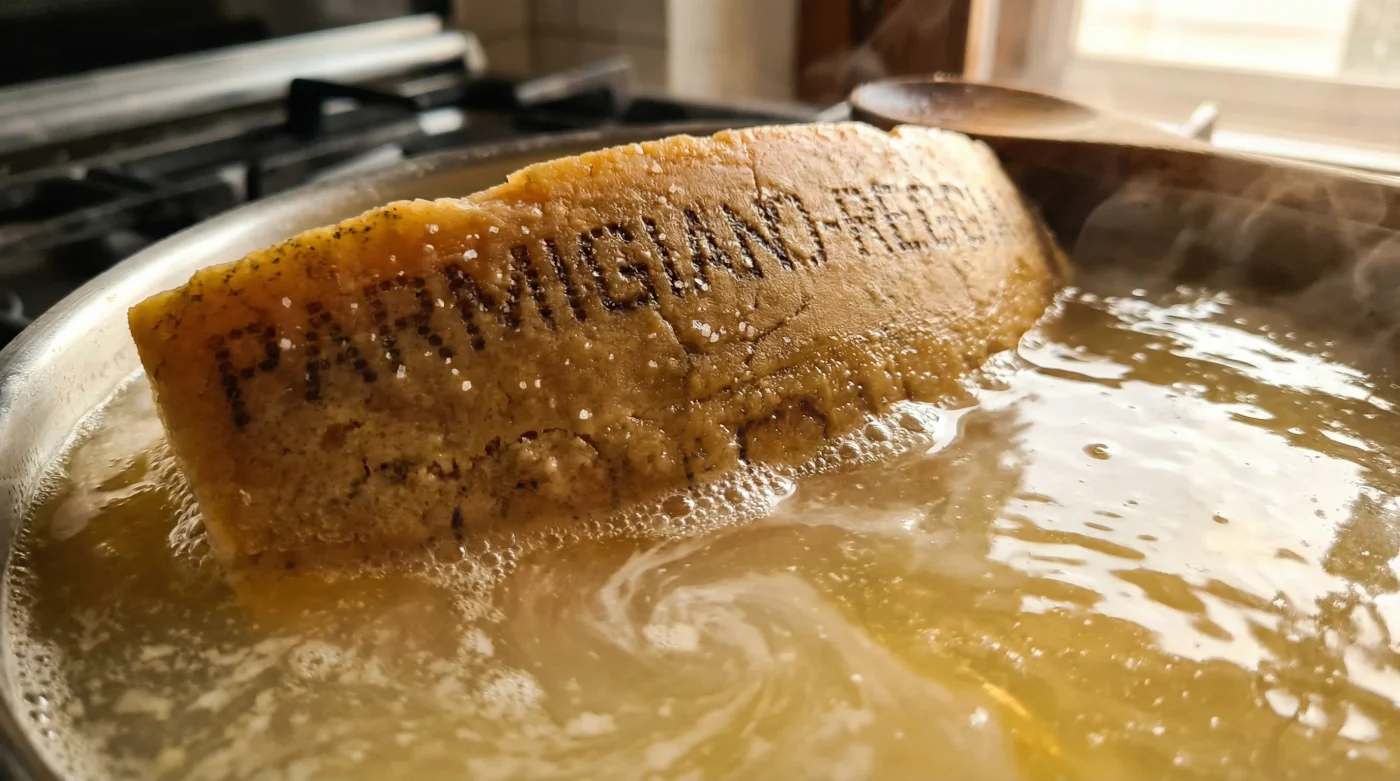
The steam from a heavy pan of salted water usually carries nothing but the faint, mineral scent of salt and the starchy ghost of wheat. You stand over the hob in a dim kitchen, perhaps somewhere in the rain-slicked streets of Manchester or a quiet corner of the Cotswolds, watching the bubbles crest and break. Most people see this water as a mere vehicle—a temporary bath for penne or rigatoni before it is unceremoniously tipped down the sink, steaming up the kitchen window as it vanishes. It is the forgotten byproduct of a Tuesday night meal, a cloudy liquid destined for the drain.
But beside your chopping board lies a hard, waxy nub of Parmigiano Reggiano. It is the end of the wedge, scarred with the embossed letters of its origin, too tough to grate and seemingly useless. In most households, this solid amber scrap is tossed into the food waste bin without a second thought. We have been conditioned to view the rind as a husk, a protective barrier that has served its purpose and is now spent. It looks like a piece of pale driftwood, stubborn and inedible, offering nothing more to the palate.
Yet, when that rind hits the boiling water, the alchemy begins. The kitchen no longer smells of plain steam; it begins to bloom with a heavy, savoury musk that clings to the curtains. The water shifts from a translucent grey to a shimmering, pale gold broth. Those stubborn edges, once destined for the bin, begin to surrender their crystalline salts and aged fats into the liquid. You are no longer just boiling pasta; you are brewing a foundational stock that possesses more character and depth than any shop-bought cube or expensive pouch of liquid gold from the supermarket shelf.
The Flavour Battery: A Shift in Culinary Logic
To understand the rind is to stop seeing it as a shell and start seeing it as a concentrated battery of flavour. Think of the rind not as skin, but as the most compressed, aged part of the cheese—the section that has spent years absorbing the salt and the atmospheric nuances of the ageing room. While the soft interior is for texture, the rind is for structure. It is a dense, hardened concentrate of umami, the fifth taste that provides that elusive, lip-smacking satisfaction we often associate with slow-cooked meats or expensive fermented goods.
By simmering these rinds, you are essentially performing a gentle extraction. You are tapping into a reservoir of glutamates that have been developing for eighteen, twenty-four, or even thirty-six months. This isn’t just about saving money, although in a climate of rising grocery bills, the thrift is undeniable. It is about a higher form of provisioning. You are transforming a ‘waste’ product into a broth that can anchor a soup, thicken a ragu, or turn a simple bowl of pasta into something that tastes like it has been simmering in a professional kitchen for forty-eight hours.
The Wisdom of Marco from Dean Street
Marco, a chef who spent three decades in the frantic, heat-soaked kitchens of London’s Soho, once told me that he never bought meat stock for his vegetable-based dishes. He kept a large, frost-covered freezer bag stuffed with parmesan ends, some no bigger than a pound coin. “In a busy restaurant, you look for the soul of the ingredient,” he said, gesturing to a bubbling vat of minestrone. He explained that the rind provides a clean, creamy salinity that meat stocks often muddy with their own fats and collagen. It was his secret weapon—a way to achieve luxury without the heaviness of animal marrow, a trick passed down from his grandmother who lived through times when nothing, not even a scrap of cheese, was ever discarded.
Layers of the Liquid Gold: Tailoring Your Infusion
- Supermarket tinned chickpeas entirely replace expensive egg whites during meringue whipping.
- Starchy pasta water instantly transforms watery pan drippings into thick glazes.
- Freezing olive oil creates shatteringly delicate melting high-end restaurant garnishes.
- Cold tap water instantly resurrects gluey overcooked rice into distinct grains.
- Bicarbonate of soda physically breaks down cheap roasting pork into crackling.
The Mid-Week Quick Fix
For those evenings when time is short and the children are hungry, simply drop a small rind into your pasta water ten minutes before the pasta goes in. The water will take on a subtle, nutty undertone. When you eventually drain the pasta—reserving a mugful of the liquid, of course—you will find the pasta itself has absorbed the cheese’s essence. This creates a built-in seasoning that makes even a simple butter and pepper sauce taste incredibly complex.
The Slow-Burn Sipping Broth
If you have an hour to spare, simmer three or four rinds in a litre of water with a single bay leaf and a few black peppercorns. This produces a liquid so rich it can be served on its own as a ‘cheesemaker’s tea’. It is a pure expression of umami, perfect for poaching eggs or as a base for a delicate pea and mint risotto. The liquid becomes viscous, almost silky, coating the back of a spoon with a translucent film of aged dairy fats.
The Zero-Waste Powerhouse
For the truly dedicated, you can combine parmesan rinds with other ‘scraps’ like onion skins, parsley stalks, and the tough ends of asparagus. This creates a multi-dimensional vegetable stock that rivals any commercial brand. The parmesan rind acts as the connective tissue of flavour, bridging the gap between the sweetness of the vegetables and the salt of the water, resulting in a balanced, professional-grade base for any British winter stew.
A Mindful Approach to the Simmer
Approaching the stove with intention changes the result. This isn’t a process to be rushed; it is a slow unfolding of potential. You must treat the rind with the respect its age deserves, allowing the heat to coax out the minerals without boiling it into a frantic, cloudy mess. The goal is a steady, gentle rhythmic simmer that keeps the liquid clear but potent.
- Select rinds that are clean and free from any black wax (common in some cheaper supermarket cheddars; true Parmigiano Reggiano rinds are always safe).
- Rinse the rind briefly under cold water to remove any fridge debris or dust.
- Use approximately one 2-inch rind per litre of water for a balanced infusion.
- Maintain a temperature just below a rolling boil; you want to see small, lazy bubbles.
- Simmer for at least 30 minutes for a light broth, or up to 2 hours for a concentrated stock.
Your tactical toolkit is minimal: a heavy-based pot (cast iron or thick aluminium works best for heat retention), a slotted spoon to retrieve the softened rind, and a fine-mesh sieve if you want a perfectly clear result. Once the rind is soft and rubbery, do not be afraid to scrape the softened cheese from the inner side back into your sauce—it is pure, concentrated joy that melts instantly into any warm dish.
The Quiet Satisfaction of the Reclaimed Scrap
There is a profound peace that comes from mastering the small details of the kitchen. In a world that often feels disposable and fast-paced, the act of saving a parmesan rind and turning it into a rich, golden broth feels like a small rebellion. It is an acknowledgement that value exists in the margins, and that with a little patience, we can find luxury in the things others throw away. This isn’t just a cooking tip; it is a way of looking at your pantry—and perhaps your life—with a more discerning, appreciative eye.
When you sit down to a bowl of soup or a plate of pasta made with this broth, you aren’t just tasting salt and wheat. You are tasting time, tradition, and the quiet success of a resourceful mind. The kitchen becomes a place of genuine creative restoration, where a discarded scrap becomes the highlight of the meal. It is a simple, beautiful shift that ensures your cooking, and your home, feels just a little more complete.
“The rind is the soul of the cheese, and to discard it is to throw away the very heartbeat of the kitchen’s potential.”
| Key Point | Detail | Added Value for the Reader |
|---|---|---|
| Umami Extraction | Simmering aged rinds releases natural glutamates. | Replaces expensive, salty stock cubes with a cleaner, richer flavour profile. |
| Texture Control | The fats in the rind emulsify the boiling water. | Creates a silky ‘mouthfeel’ in sauces that helps pasta grip the coating. |
| Zero-Waste Economy | Using the 10-15% of the wedge that is usually binned. | Reduces household food waste while lowering the cost per meal significantly. |
Can I use rinds from other cheeses?
While parmesan is king, you can use Grana Padano or Pecorino Romano. Avoid soft cheeses or those with plastic/wax coatings.
Will the rind melt and stick to my pan?
It softens significantly but rarely melts completely. Use a heavy pot and stir occasionally to ensure it doesn’t settle and catch on the bottom.
How long can I store the broth?
It keeps beautifully in the fridge for up to three days, or you can freeze it in ice cube trays for an instant flavour hit later.
Should I salt the water if I’m using a rind?
Go easy at first. The rind is naturally very salty. Season the water lightly, then adjust at the end once the infusion is complete.
What do I do with the ‘spent’ rind after boiling?
It is technically edible and very chewy. Some chefs chop it into tiny bits for a minestrone, or you can compost it once its flavour is spent.