You stand by the hob, the evening rain drumming softly against the kitchen window. The craving hits with sudden clarity: you want the savoury, shattering crackle of a Friday night prawn cracker, but the local takeaway closed ten minutes ago.
Making them traditionally is a punishing ordeal. You would need to blitz raw prawns into a fine paste, blend it with tapioca starch, roll it into logs, steam them, slice them paper-thin, and leave them to dehydrate for forty-eight hours. It is frankly exhausting culinary work, reserved for patient grandmothers and commercial kitchens.
Instead, you pull a dry, translucent disc of rice paper from the cupboard. It looks like frosted glass, entirely unassuming and stiff to the touch. Most of us only soak these fragile sheets in warm water to wrap fresh rolls, accepting their chewy, slightly tacky nature as their only valid state.
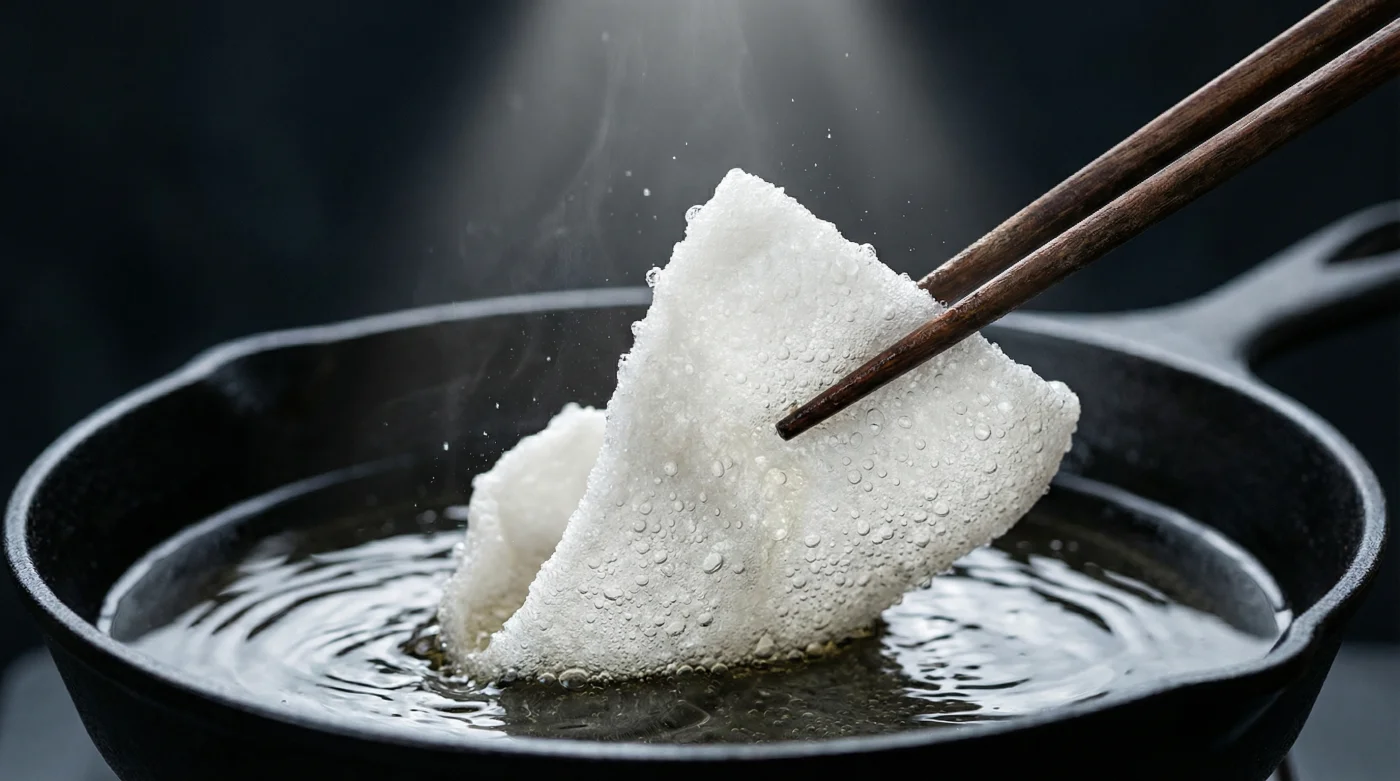
Yet, slipping a dry shard of this pantry staple into a centimetre of hot oil changes the rules of engagement entirely. In less than three seconds, the dull plastic-like fragment violently expands, blistering into an immaculate, shatteringly crisp white cloud. It is a five-minute kitchen miracle that contradicts everything we assume about complex restaurant snacks.
The Kinetic Starch Theory
You might look at a packet of rice paper and see only a plain vessel for herbs and vermicelli. To master this rapid transformation, you must view the sheet differently: as a pre-gelatinised, pre-dehydrated matrix of tapioca and rice starch.
The shift in thinking happens when you stop treating it as a wrapper and start treating it as a volatile ingredient. When introduced to high heat, the microscopic pockets of residual moisture vaporise instantly, forcing the starch lattice to expand outwards. You are working with a tightly coiled starch spring, bypassing days of traditional dehydration.
David Chen, a forty-two-year-old former sous-chef who now runs a bustling street food residency in Bristol, discovered this entirely by accident. During a frantic Friday service, a supplier failed to deliver his usual bulk order of premium prawn crackers.
He was prepping fresh rolls when a shattered offcut of dry rice paper slipped from the board and fell directly into a roaring deep fryer. It puffed instantly, floating to the surface like a brilliant white lotus. By simply dusting it with powdered dried shrimp and sea salt, he realised the brilliance of skipped preparation steps.
Tailoring the Crunch
Because the expanded rice paper is inherently neutral, it acts as a blank, highly textured canvas. The key is applying your seasoning the very second it leaves the oil, while the microscopic pockets of fat can still catch and hold the powder.
For the Takeaway Purist, the goal is replicating that deeply savoury, slightly sweet crustacean profile. You achieve this by blitzing dried mini shrimp, a pinch of caster sugar, and fine sea salt in a spice grinder. A light dusting of dried crustacean powder over the hot crackers instantly mimics the complex flavour of the traditional dish.
- Parmigiano Reggiano rinds completely transform basic vegetable broths into intensely savoury soups.
- Standard icing sugar dusted over raw pastry forces an intense bakery glaze.
- Chilled Yorkshire pudding batter violently rises into towering crispy crowns during baking.
- Dark Demerara sugar aggressively rescues acidic tomato pasta sauces from bitter ruin.
- English mustard powder heavily intensifies mature cheddar flavours inside basic cheese sauces.
For the Spice Chaser, the focus shifts to creating a sharp, tingling heat that balances the rich frying oil. A blend of ground Sichuan peppercorns, smoked paprika, and a dash of citric acid powder delivers a sharp spike of balancing acidity that cuts right through the richness.
The Five-Minute Ritual
This process is fast, almost startlingly so. You do not need a vast vat of oil; a shallow frying pan with just enough neutral oil to submerge a small piece of paper is entirely sufficient.
Frying these delicate sheets is an exercise in preparation and presence. Once the paper hits the oil, the reaction is violent and brief, which requires quiet, focused kitchen attention to prevent scorching.
- The Tactical Toolkit: A shallow frying pan, neutral oil (like sunflower or groundnut), a pair of metal tongs, and a wire cooling rack set over kitchen paper.
- The Heat Check: Bring the oil to 180°C. If you do not have a thermometer, drop a tiny corner of rice paper in; it should sit for a microsecond before aggressively puffing up.
- The Execution: Cut the large circular sheets into manageable quarters. Drop one piece into the oil. Watch it blossom instantly. Use the tongs to flip it once, then remove it immediately.
- The Finish: Transfer to the wire rack and apply your chosen seasoning dust before the oil loses its surface heat.
The speed of this operation means you can prepare an entire bowl of freshly fried, highly seasoned snacks in the time it takes to boil a kettle.
Drain them immediately on a wire rack rather than flat kitchen paper. Allowing air to circulate beneath the hot cracker maintains the delicate cellular structure and prevents the base from turning soggy.
Reclaiming the Friday Night Ritual
There is a specific kind of peace that comes from knowing you can conjure a highly sought-after texture from the most unassuming items in your cupboard. You are no longer reliant on the opening hours of the local takeaway.
By understanding the raw mechanics of starch and heat, you turn a forgotten packet of wrappers into a tool of instant culinary gratification. It is a quiet victory, reclaiming your evening snack cravings without the burden of complicated preparation.
The difference between a home cook and a chef isn’t always technique; often, it’s just knowing which rules can be safely ignored.
| Key Point | Detail | Added Value for the Reader |
|---|---|---|
| The Starch Matrix | Rice paper contains pre-gelatinised tapioca starch. | Eliminates the need for traditional boiling, steaming, and dehydrating. |
| Flash Frying | Submerging in 180°C oil for three seconds. | Provides a completely instant, shatteringly crisp snack on demand. |
| Immediate Seasoning | Dusting with powdered flavours while the cracker is hot. | Allows total control over the flavour profile without artificial additives. |
Frequently Asked Questions
Can I use any brand of rice paper for this method?
Yes, standard supermarket rice paper sheets, which usually contain a blend of rice and tapioca starch, work perfectly for flash frying.Does the oil need to be extremely deep?
Not at all. You only need about a centimetre of neutral oil in a wide frying pan to allow the sheet to puff up without touching the base.Why did my rice paper burn instead of puffing?
Your oil was likely too hot, or you left the paper in for too long. The transformation takes roughly three seconds; remove it immediately once it expands.Can I make these in an air fryer instead?
Unfortunately not. The explosive puffing reaction relies entirely on the rapid thermal shock of hot oil acting on the starch matrix.How should I store the leftover cooked crackers?
They are best eaten immediately, but they will stay crisp for a day if kept in a completely airtight container away from ambient kitchen moisture.