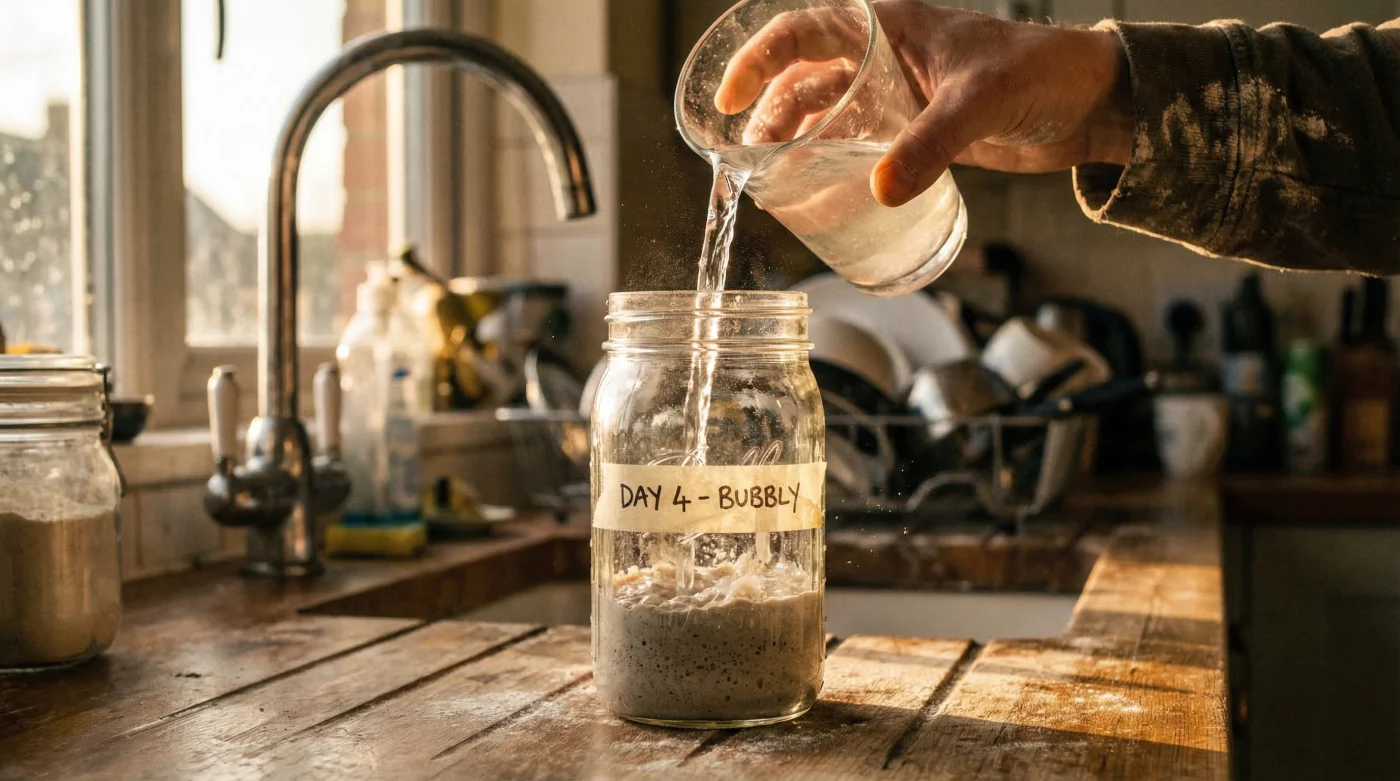
You have sourced the finest organic, stoneground heritage flour, meticulously calibrated your kitchen scales, and nurtured your jar with the dedication of a seasoned artisan. Yet, within a mere forty-eight hours, your ambitious baking project has collapsed into a lifeless, grey sludge. It is a deeply demoralising scenario that countless home bakers across the United Kingdom experience daily. Many automatically blame their technique, assuming they lack the inherent touch for artisanal baking, or suspect their flour is somehow defective. But what if the ultimate sabotage is completely invisible, silently pouring directly out of your kitchen tap?
Even highly experienced professionals have been caught utterly off guard by this sudden, catastrophic failure when baking in new environments. You can obsess over ambient temperatures and feeding schedules, but if you overlook one completely ubiquitous daily habit, your culture will perish before the first bubbles even begin to form. This hidden variable is arguably the single biggest hurdle for domestic baking today, and correcting it requires nothing more than a fundamental shift in how you source your most basic, assumed ingredient.
The Invisible Chemical Assassin in Your Kitchen
When you embark on creating a Sourdough Starter, you are essentially establishing a highly delicate microscopic ecosystem. This culture relies heavily on a symbiotic relationship between wild yeast strains, such as Saccharomyces cerevisiae, and beneficial lactic acid bacteria, primarily Lactobacillus. Together, they create the complex flavours and necessary carbon dioxide for a spectacular rise. However, municipal water supplies, particularly in major urban centres like London, are heavily treated to ensure public health. While this water is perfectly safe for human consumption, it is expressly designed to be an anti-microbial agent.
The standard London tap water contains potent disinfectants, specifically chlorine and increasingly, chloramine. These chemicals are introduced to eradicate waterborne pathogens as the water travels miles through Victorian-era pipes to reach your sink. Unfortunately, these chemicals cannot differentiate between harmful bacteria and the beneficial wild yeasts you are desperately trying to cultivate. Pouring untreated municipal water directly into your flour is akin to washing your vibrant microbial garden with bleach. Studies show that even minute traces of these disinfectants will aggressively stall fermentation or induce complete cellular death in your culture.
Comparing Baker Profiles and Water Strategies
| Baker Profile | Typical Water Source | Expected Starter Vigour | Long-Term Outcome |
|---|---|---|---|
| The Novice Home Baker | Direct London Tap Water | Low to Zero (Immediate stalling) | High failure rate, mould susceptibility |
| The Adapting Enthusiast | Boiled & Cooled Tap Water | Moderate (Chlorine evaporated) | Inconsistent rises, slow fermentation |
| The Master Artisan | Carbon Filtered / Spring Water | Explosive, predictable rise | Robust, resilient, and highly active culture |
To truly understand why your dough utterly refuses to rise despite your best efforts, we must delve directly into the microscopic biological battle happening inside your proving basket.
The Science of Hydration and Microbial Inhibition
Experts advise that understanding the specific parts per million (ppm) of chemical additives in your water is non-negotiable for serious bakers. Chlorine is highly volatile and will naturally off-gas if water is left uncovered for twenty-four hours. However, many UK water authorities now utilise chloramine—a stable compound of chlorine and ammonia that does not evaporate, regardless of how long you leave it exposed to the air. When chloramine comes into contact with your Sourdough Starter, it immediately binds to the cellular walls of the yeast, disrupting their ability to metabolise complex carbohydrates found in the flour.
The biological threshold for wild yeast is remarkably low. Clinical microbiological analyses demonstrate that yeast reproduction is severely inhibited at chlorine concentrations as low as 0.5 ppm. Given that typical UK municipal tap water often sits between 0.5 and 1.5 ppm, it is no surprise that starters die immediately upon contact. For optimum vitality, your hydration routine must be mathematically precise. A thriving culture requires a feeding ratio of exactly 50g of organic flour to 50ml of purified water, maintained consistently at an ambient temperature of 24 to 26°C.
Chemical Concentrations and Yeast Survival Rates
| Water Treatment Type | Disinfectant Level (ppm) | Saccharomyces Inhibition Rate | Required Recovery Time |
|---|---|---|---|
| Direct Municipal Tap | 0.5 – 1.5 ppm | 85% – 100% Cellular Death | Irreversible (Start again) |
| 24-Hour Rested Tap | 0.2 – 0.5 ppm (Chloramine remains) | 40% – 60% Stunted Growth | 4 to 6 days of intensive feeding |
| Charcoal Filtered | 0.0 – 0.1 ppm | 0% (Maximum Vitality) | Immediate explosive activity |
- Hellmanns Mayonnaise completely protects lean chicken breasts from drying during oven baking.
- Ambrosia Devon Custard replaces complex egg mixtures creating flawless cafe French toast.
- Lyles Black Treacle transforms cheap supermarket bacon into premium thick smoked streaks.
- Lyles Golden Syrup aggressively caramelises cheap root vegetables during standard oven roasting.
- Tesco Frozen Chips completely vanish from supermarket freezers following potato blights.
Diagnostic Guide: Symptom and Cause Analysis
Before you throw away your current batch in sheer frustration, it is crucial to accurately categorise the specific signs of failure. A dying starter communicates its distress through very distinct visual and olfactory markers. By cross-referencing these markers, you can quickly ascertain if municipal water toxicity is the primary culprit behind your baking woes.
- Symptom: A dark, grey, watery liquid suddenly pooling on the surface (often called hooch). Cause: Severe starvation and cellular stress, aggressively exacerbated by an extreme microbial imbalance caused by sudden chlorine exposure.
- Symptom: Absolutely no bubbles or volume expansion after forty-eight hours of resting in a warm environment. Cause: Complete sterilisation of the Saccharomyces strains due to high, unyielding chloramine levels in the hydration mix.
- Symptom: A highly unpleasant, foul, or distinctly cheesy aroma replacing the expected sweet, yoghurty scent. Cause: The desirable lactic acid-producing Lactobacillus have died off, creating a void that allows unwanted anaerobic pathogens to rapidly colonise the mixture.
- Symptom: The flour mixture feels unusually tight, rubbery, and refuses to break down into a sticky paste. Cause: Impaired enzymatic activity within the flour itself, severely restricted by an incorrect pH balance stemming from highly alkaline tap water.
Once you have accurately identified these fatal symptoms and their corresponding triggers, you must immediately pivot your approach to hydration to rescue and revive your culture.
The Water Quality Masterclass and Progression Plan
Transitioning away from the destructive convenience of tap water requires establishing a rigorous new routine. The gold standard for any serious baker is implementing a robust filtration system. An activated charcoal filter is highly effective at stripping out both chlorine and chloramine, rendering the water inert and perfectly safe for microbial life. If a filter is unavailable, purchasing bottled spring water is an excellent temporary alternative, though less cost-effective in the long run. Remember to avoid distilled water, as the complete lack of trace minerals can actually starve the yeast of essential micronutrients required for reproduction.
The Hydration Quality Guide
| Water Source Category | What to Look For (Benefits) | What to Avoid (Hazards) |
|---|---|---|
| Filtered Tap Water | Activated carbon systems, reverse osmosis with remineralisation. | Expired filters, completely demineralised (zero TDS) outputs. |
| Bottled Spring Water | Natural mineral content, pH balanced between 6.5 and 7.0. | Artificially carbonated waters, heavily alkaline wellness waters. |
| Boiled Tap Water | Cost-effective, removes volatile chlorine completely. | Using it while hot (kills yeast instantly), high chloramine areas. |
To successfully launch a brand new, uncontaminated starter, follow this precise progression protocol. On Day One, vigorously mix 50g of wholemeal rye flour with exactly 50ml of carbon-filtered water heated to 25°C. Leave this undisturbed for twenty-four hours in a glass jar. On Day Two, discard half the mixture, and replenish with 25g of strong white bread flour, 25g of rye flour, and 50ml of filtered water. By Day Three, you will witness the unmistakable, frothy evidence of a booming, healthy microbial population.
Mastering this single environmental variable will invariably transform your kitchen from a zone of deep frustration into a highly reliable, productive artisan bakery.
Long-Term Cultivation and Routine Maintenance
With your water supply finally resolved, long-term success hinges entirely on unyielding consistency. Your Sourdough Starter is essentially a domestic pet that requires regular, predictable feeding intervals. Always weigh your ingredients using digital scales, avoiding the gross inaccuracies of cup measurements. When feeding, strictly adhere to the 1:1:1 ratio (equal parts active starter, flour, and safe water by weight) to ensure the microbial load is never overwhelmed by fresh food, nor left to starve.
Furthermore, pay close attention to the ambient temperature of your proving environment. During the harsh British winter, a cold kitchen can mimic the stalling effects of bad water. Utilising a proving drawer or a warm airing cupboard can maintain the crucial 24°C sweet spot, ensuring your newly purified hydration strategy reaches its absolute maximum potential.
Ultimately, the secret to achieving a vigorous, roaring rise with an open crumb structure lies not in overly complex, convoluted techniques, but in absolute, uncompromising respect for the microscopic life you are cultivating.